Hello
I am a student and I know some interesting things about the planet in our solar system.
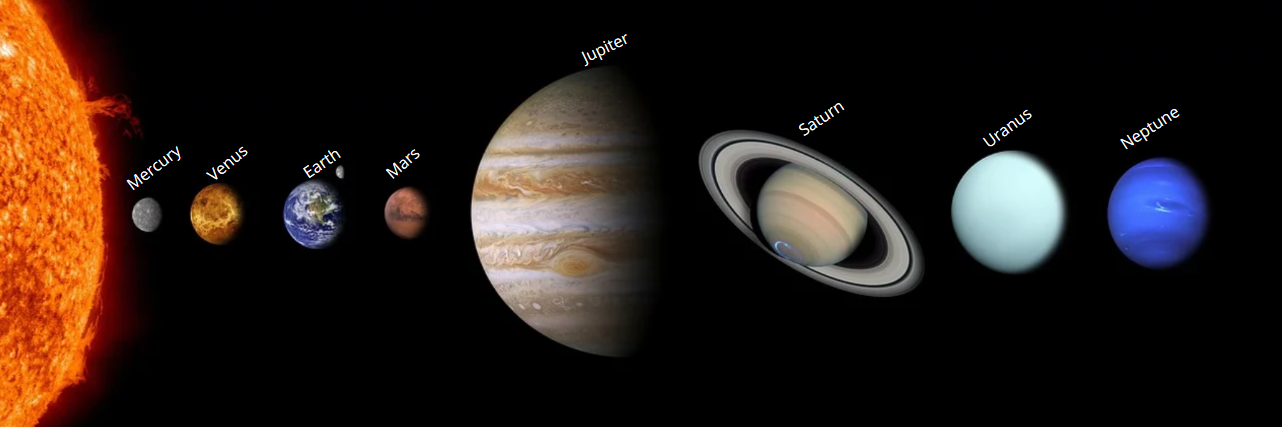
The Planets in order from the sun are Mercury, Venus, Earth, Mars, Jupiter, Saturn, Uranus, Neptune, and finally the dwarf planet Pluto.
1) Mercury:-
It is the first planet in our solar system. It is slightly smaller than Earth’s moon and is extremely hot.
~> Size relative to the earth is 38%.
~> Orbit time: 88 Earth days
~> It has a diameter of 4,879.4 km.
~> Distance from the sun is 67.461 million km.
~> Mass is 3.3022 x 10²³
~> Sunlight takes 3.2 minutes to travel from the Sun to Mercury.
2) Mars:-
Mars is the fourth planet from the sun and is the last terrestrial planet. Mars is the focus of NASA and SpaceX because it is the only planet that humans can somewhat survive on (with the help of technology and science, of course).
~> Size relative to the earth is 53%.
~> It has a diameter of 6,779 km.
~> Distance from the sun is 249.24 million km.
~> Mass is 6.4185 x 10²³.
The Earth is the third planet from the sun and is the planet that we call home. It is the only planet, that we know of, that can maintain and support life. Earth has formed around 4 billion years ago and has gone through many changes in that time. Earth has 4 seasons because of the tilt of Earth’s axis, and our oceans have tides because of the gravitational pull of the moon. The moon is our only natural satellite.
~> 1 orbit around the sun takes 365 days
~> 1 day is 24 hours.
~> It has a diameter of 12,742km.
~> Distance from the sun 151.18 million km.
~> Mass is 5.9736 x 1024
Neptune is the eighth planet from the sun and is the last of the gas giants. It is comprised of hydrogen and helium primarily and is surrounded by a thick cloud layer that houses winds faster than the speed of sound. The blue coloring is produced by an abundance of methane and it is unknown if Neptune’s core is solid. Neptune was predicted to exist by math before we actually saw it, making it the first predicted planet.
It was officially discovered in 1846
.
~> Size relative to the earth is 388%.
~>It has a diameter of 49,244km.
~>Distance from the sun is 4.4752 billion km.
~> Mass is 10.243 x 1025
Uranus is the seventh planet from the sun and is the third of the gas giants. Just like Jupiter and Saturn, the Voyager probe gave us our first look at the planet in 1986. Our first images of Uranus came on the same day that the Challenger blew up, killing the 7 astronauts on board.
~> Size relative to the earth is 400%.
~> It has a diameter of 50,724km.
~> Distance from the sun is 2.9526 billion km.
~> Sunlight takes 2hours 40min to travel from the sun to Uranus.
~> Mass is 8.6810 x 1025
Saturn is the second gas giant and is our second largest planet. Saturn was also seen by Voyager as you can see in the picture above. Saturn is most recognizable by its rings that are made up of ice and space debris. Saturn is comprised of hydrogen and helium, but it is unknown whether Saturn has a solid core (just like Jupiter). Saturn also has quite a few natural satellites as well.
~> Size relative to the earth is 945%.
~> It has a diameter of 116,460km.
~> Distance from the sun is 1.4852 billion km.
~> Sunlight takes 74.86 min to travel from the sun to Saturn.
~> Mass is 5.6846 x 1026
8) Jupiter:-
Jupiter is the first of the gas giants and is the largest planet in our solar system. We got our first images of Jupiter up close from the space probe Voyager, which is actually still flying through space outside of our solar system. Jupiter is comprised primarily of hydrogen and helium and it is still unknown if Jupiter’s core is solid or not. If Jupiter were about 80 times its size then it would be considered a star, just like our Sun. Jupiter has a lot of natural satellites surrounding it, which are believed to be from meteors. Jupiter actually protects the earth from meteors, so in a way, Jupiter is kind of Earth’s protective big brother.
~> Size relative to the earth is 1120%.
~> It has a diameter of 139,820km.
~> Distance from the sun is 751.86 million km.
~> Sunlight takes 35 to 52min to travel from the sun to Jupiter.
~> Mass is 1.8986 x 1027
Comments
Post a Comment
If you have any doubt on any topic please tell me